I might have mentioned a few times – I’m excited, after all – that I’ve written a book on razor and shaving related patents… the Kindle edition is dropping on the 15th of March (you can preorder it now) and the paperback is now available too – so if you order it now, you’ll get it as early as the electronic version!
Ralph E Thompson and the amazing tilting adjustable razor
Ralph E Thompson was – as we’ve already seen – a rather prolific inventor of safety razors and associated gear, and he seems to have been one of the central characters in Gillette’s search for an improved, adjustable razor in the early 1930’s. As the preamble for the patent puts it:
This invention relates to safety razors, and more particularly to means for so adjusting the razor and blade as to vary the blade edge exposure thereof. Some beards require a considerable exposure of the blade edge if a satisfactory shave is to be secured while other beards require a much less exposure. The ideas of different people vary to a great extent in this matter and, furthermore, the same person may at one time desire a close shave and. at another time a rather rough shave.
So far so good; people have different ideas of how aggressive a razor should be, and people’s needs vary from day to day. Obvious for us today, who have grown up with adjustable razors, but in the context of the time it was perhaps less so. How Mr Thompson made the razor adjustable was very different than the methods we’re used today, and when adjusted it gave the shaver an aggressive and a mild edge to shave with.. useful, perhaps, in that you could do the first pass with one side and touch ups with the second.
In accordance with my invention, I so mount and preferably pivot a stud I to the cap that movement thereof causes such a relative transverse adjustment between the blade and guard as to. secure the said variations in blade exposure, the handle being adapted to cooperate with the stud to clamp the parts in the adjusted positions.
In the accompanying drawings I have illustrated certain specific embodiments of my invention but it, will be understood that the invention can be otherwise embodied and that the drawings are not to be construed as defining or limiting the scope of the invention.
So by tilting the base plate and cap in relation to the handle, the blade gap and blade exposure could be adjusted – as can be seen in figures 4 and 6 on the drawing. A potential improvement to Mr Thompson’s invention might be to flatten the very top of the cams (labelled as #32 in the drawings) slightly, so that the neutral position could easily be found.
The patents is – naturally – long since expired, and thus available if any daring razor manufacturer wishes to market out a truly unique, infinity variable adjustable razor that gives you a mild and aggressive shave at the same time.
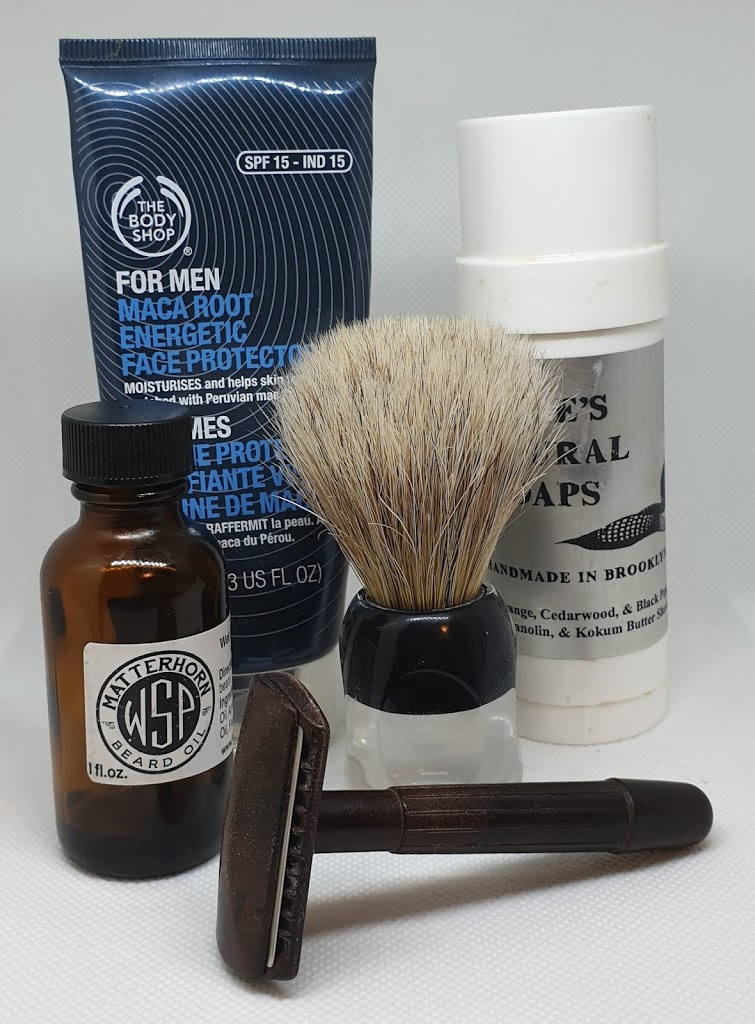
Shave of the day 9th March
Shave of the day 6th March
PS: The Kindle edition of my book 70 razor and shaving patents is available for preorder at getbook.at/70razor_shavingpatents
Kindle edition of “70 razor and shaving patents” available for preorder
Today is a big day for me; today is the day that the kindle edition of my book 70 razor and shaving patents became available for preorder!
You can preorder it at http://getbook.at/70razor_shavingpatents – feel free to share to link to anyone interested. The official release date is March 15th 2020, and it will also be available in paperback.
New and useful Improvements in Safety-Razor-Blade Packages,
If your freshly invented razor relies on replaceable blades, you better come up with a way to pack the blades. And that goes double if your blades isn’t perfectly flat, such as the blades for the GEM and EverReady razors.
Enter Joseph Kaufman – of the American Safety Razor Corp – and the patent he filed in January 1907 for how to package a single edge razor blade with a spine. In hindsight the invention is obvious, but it was novel enough in 1907 to be granted a patent. In the words of the patent:
The combination with a safety razor blade having longitudinal shoulders, of a paper slip of much greater length than width and open at the top and having closed ends, the blade being inserted into the slip. the shoulders of the blade resting on the upper edges of the slip and the cutting edge of the blade being a short distance inward from the bottom edge of the slip, and an envelop surrounding the blade and slip, and a retaining and sealing band surrounding the envelop, substantially as set forth.
So in short; a paper wrap around the blade – making the blade as wide as the spine and protecting the edge – and a paper envelope around that.
I got some new-old-stock Radio Steel EverReady blades – inherited from a friend of the family as part of a EverReady 1914 kit – and those blades are packet exactly as the patent describes. And when I bought modern GEM blades loose – that is, not in a dispenser – they had the card-stock wrapper around the blade proper.
Shave of the day 4th March
March 15th 2020…
Square blade ends
We might not think about it today, but those of us who uses vintage razors dating to before the mid 1930’s are actually using them with a blade they were not designed for – but the blade we’re using was designed to be compatible with them. And while the blade shown in this advertisement that ran in the June 1930 edition of Scientific American isn’t identical to the blade we know and love, it’s more than halfway there… Gillette just needed a lawsuit and a messy corporate merger with the American Safety Razor Company to get all the way there.
As an aside, this blade is probably the one covered by US patent US1850902A, filed in 1929. I might go into details on that at some point.