Improvement in shaving-mugs

Shaving mugs comes in all shapes and sizes, from a re-purposed plastic cup to intricate scuttles… but in this day and age you don’t often see something as complicated as the useful improvement in shaving cups that was patented by Andrew J. Fuer and Walter C. Knaus in late 1873.
It has to be remembered that this was well before hot water taps were a common fixture… I mean, as far as I know even having running water inside would be on the bleeding edge of technology, and keeping your lather warm must been a lot harder back then.
A scuttle that was simple in construction and convenient to use must have been seen as a gift from the heavens for the serious shaver, and looking through the patent shows a design that at the very least fulfils the first of those two things;

A is a cylinder made of sheet metal, and provided at its lower end with a base, B. In the lower end of the cylinder A is fitted a small lamp, C, in which may be burned kerosene, alcohol, or other burning-liquid. To the opposite sides of the lamp C are attached pins, which enter bayonet-slots in the lower end of the cylinder A, so that the lamp can be conveniently attached and detached when desired. In the lower part of the cylinder A is formed a row of holes a little below the burner of the lamp C to allow the air to pass in freely to support combustion. In the upper part of the cylinder A is formed a cup or receptacle, D, to contain water. In the side of the cylinder A, a little above the bottom of the cup D, is formed  a hole leading into a small chamber, E, attached to the, side of the upper part of the cylinder A, and which should be of` sufficient size to allow the shaving-brush to be inserted. In the other side of the upper part of the cylinder A, just below the bottom of the cup D, is formed a` hole leading into the pipe F, attached to the side of the cylinder A, to serve as a chimney or line to carry off the heated air and the gaseous products of combustion, and to form a draft to promote combustion. In the upper end of the cylinder A is fitted a small cup, G, in which the soap is placed, and in which the lather is made. The cup G has a flange formed around its upper edge to rest upon the upper edge of the cylinder A, and `the said cup G should be such a depth as to extend down into the water in the cup D, so that the lather .may be kept warm.

A fairly straight forward and easy to understand description, especially for a patent. And if that was hard to follow, the drawing is also a model of clarity compared to some other patents I’ve had a look at lately.

There are a couple features of this patent that shows me that Mr Fuer and Mr Knaus at the very least had thought thigns through before applying for the patent: The bayonet-lock that makes sure the heat source stays in place, and the wide base that prevents the improved shaving mug from falling over spilling hot water and possible being a fire risk.
The only downside I see with this patent in light of when it was applied for and granted is the fact that the burner will heat up your bathroom, summer and winter – a small price to pay for hot lather.
I have no idea if this improved shaving mug ever went into production… it would be a shame if it wasn’t put on the market.

Shave of the day 5th November

Razor: GEM 1912
Blade: GEM Single Edge Stainless
Brush: Semogue TSN LE 2012
Lather: Asylum Shave Works Frankincense & Myrrh
Aftershave: Asylum Shave Works Frankincense & Myrrh
Additional Care: Alum Block, Scotch Porter Beard Balm, & Pereira Shavery Boomerang Beard Comb

Shave of the day 2nd November

Razor: Ever Ready 1914
Blade: GEM Single Edge Stainless
Brush: Gustavo Rimano Manchurian Badger, imitation horn
Lather: Mike’s Natural Soaps Orange, Cedarwood & Black Pepper
Aftershave: Myrsol Aqua De Limón
Additional Care: Alum Block, BullDog Original Beard Balm, & Pereira Shavery Boomerang Beard Comb

PS: Remember the unbreakable bowl from Pereira I reviewed a little while ago? It’s now available via Indiegogo, for a quite reasonable price too. And there is a limited number of them available with free shipping too!

Bifurcated yoke razor

From time to time I spot an old patent where I can see what they tried to achieve, yet have to wonder about details in how they tried to achieve it.

One of those is Roger C Edson’s patent from 1968 for a razor with a pivoting head. Today a pivoting head is de rigueur when it comes to cartridge razors, but fifty years ago in the last days of the era of widespread use of DE razors it was significantly less common.

Mr Edson was obviously inspired by the double edge razor, in that his invention featured a razor head that had a cutting edge on both sides. He did however elect NOT to use DE blades, for reasons unknown. As for how he made the razor head pivot, well, lets turn to the description in the patent:

…a razor having a bifurcated yoke at one end of a handle and on which a blade carrier is pivotally mounted to rock.

Okay.. so a Y-shaped handle with the head mounted between the two arms. Of the top of my head I can think of two or three ways to mount a head that uses a DE-blade in that configuration; either using a thumbscrew underneath the head or the two arms of the handle to lock the base plate and cap securely together. Mr Edson on the other hand… well, lets read on in the patent:

The blade carrier has surfaces for replaceably mounting a pair of blades in an opposed inclined relationship with a space between adjacent cutting edges. Each of the blades then acts as a guide for the opposite blade as they are moved in opposite directions and the carrier pivots to follow the contour of the surface being shaved.

Ooookay. Two blades, not one. And it gets even stranger when you actually look at the drawings that shows the invention.

Have a closer look at figures 1, 2 and 3. Notice anything out of the ordinary? Yes, Mr Eson did opt to use machine screws and nuts to attach the blades to the razor head, would wouldn’t glide too smoothly over the skin. Yes, it does look like the blades have a certain amount of sideways play. But what I noticed first is that the cutting edges of the blades both point to the middle of the razor head!
This little detail is mentioned towards the very end of the patent, in the summary:

A safety razor comprising a handle, a blade carrier mounted to be freely rockable on the handle, means on said carrier to support and position a plurality of replaceable blades, said blade carrier constructed to mount said blades such that the shaving edges of a pair of said blades face one another and are spaced apart sufficiently for a ridge of skin to be pressed between the edges and further to mount said blades at an angle relative to each other such that when one blade is drawn flatly across the skin acting as a guard and guide for the cutting edge of the other facing blade the latter is positioned so as to produce the proper shaving angle therefor.

Needless to say I can’t find any evidence that Mr Edison’s razor was ever manufactured and sold. If nothing else the use of machine screws and nuts makes changing blades much harder than it ought to be, and that alone would be enough to doom it in the marketplace.

Spooky shave of the day 31st October

Razor: Ever Ready 1914
Blade: GEM Single Edge Stainless
Brush: Vie-Long #12705B
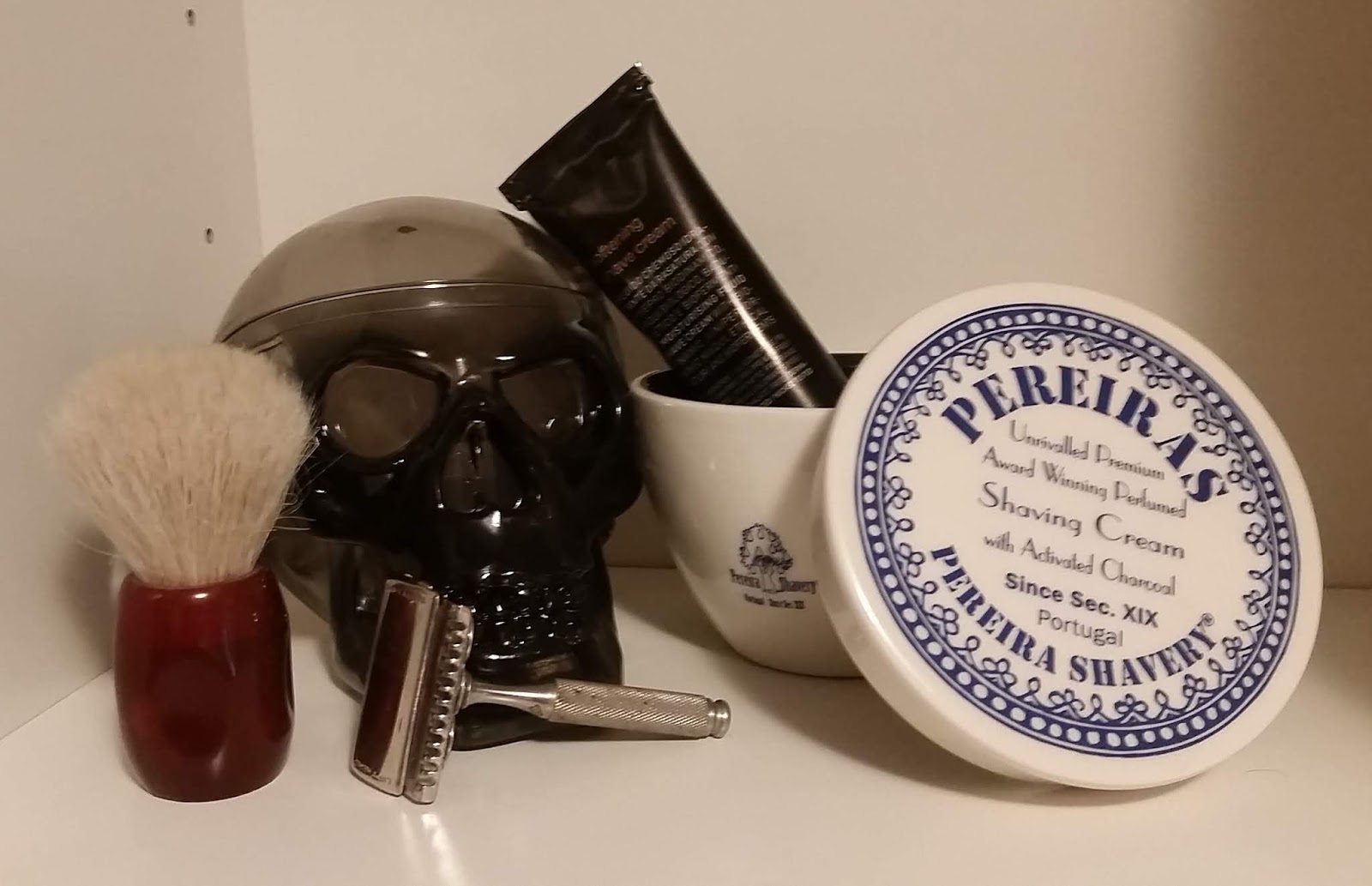
Lather: Pereira Shavery Shaving Cream w/ Activated Charcoal and and a touch of Oway softening shaving cream
Aftershave: Barber No3 Marmara
Additional Care: Alum Block, Gentlemen of Sweden Original Beard Oil, & Pereira Shavery Boomerang Beard Comb

PS: Remember the unbreakable bowl from Pereira I reviewed a little while ago? It’s now available via Indiegogo, for a quite reasonable price too.

Pereira’s unbreakable shave bowl with free shipping

Wondering about supporting Pereira Shavery’s crowdfunder and get one of the unbreakable shaving bowls they are offering? What if I told you that you have the opportunity to get it with free shipping?

That’s right; there is a limited number of perks available that means you can get the bowl without having to pay shipping. They will go fast, I’m sure, so don’t ponder too long 🙂

Just follow this link to get it.

Weird patents: “Toilet-brush”

Sometimes a patent covers an invention which is so obviously an improvement on the state of the art that you wonder why no one have though about it before… and other times it covers an invention that history have passed by. George L Street Jr’s patent from August 1908 is one of the later.

The title of the patent is “toilet-brush”, but reading the patent makes it abundantly clear that what it means is a brushed used for a person performing one’s toilette and not for cleaning a potty. The meaning of words can drift over time…

Returning to the patent, it is claimed to be a “a certain new and useful Improvement” over previous brushes used for personal grooming, “especially applicable to shaving and tooth brushes”. As to why the brushes used for personal grooming needed to be improved, lets turn to the text of the patent:

One of the objects of the invention is to eliminate the use of a shaving cup, and cake or stick or of any detergent and holder therefor, such as is liable by repeated use to accumulate and harbor impurities and disease producing’ germs…

As to how this was to be achieved… for starters, the brushes were designed to allow easy cleaning of the base of the bristles (aka: the glue bump). This was supposedly achieved by making the brush capable of being opened up; the drawings that accompanies the text shows hinges along one side of the handle.

Freedom from the perceived bio-hazard on your shaving soap or in your shaving cup came from the ability to place soap directly inside the brush after opening it up. To quote from the patent text:

…an attenuated, pliant body of soap or detergent of proper size for a single use and which soap or detergent will lie .within or between the bristles and partake of their movement…

One version of the brush showed in the drawing includes a storage space in the handle for several of the soap wafers – useful, one would imagine, for a travel brush.

The patent also describe how the soap wafer would be made from a pliable material such as paraffined paper partially covered in soap, since soap by itself isn’t structurally sound and would disintegrate before a lather could be worked up.

With the benefit of hindsight, it’s easy to see why Mr George L Street Jr’s brush didn’t stick around… not only is the danger of germs on our soaps significantly less than the patentee seems to have believed, but a shaving brush with one or two small hinges is an invitation for a broken brush. You would also be locked in to a single source of shaving soap; however this was probably less of a worry in 1908 than most of traditional wetshavers would consider it in 2018.

No shave of the day 29th October

There is something… almost sinful about going to a professional barber for a straight razor shave. The hot towels, the massage, the pre-shave oil, the lather, the post-shave massage with a face tonic…

…and, off course, the fact that my cheeks are so smooth even the day after that I don’t have to shave on a Monday morning!

PS: Remember the unbreakable bowl from Pereira I reviewed a little while ago? It’s now available via Indiegogo, for a quite reasonable price too.

No shave, but a PSA of sorts

For various reasons – mostly to do with an idea for tomorrow – I’m not shaving today.. but I can take the time to tell you all that if you want in on the Pereira Shavery unbreakable lather bowl crowdfunder and get the bowl with 50% off shipping, you need to act soon – not only are the offer limited in number, but it only last a couple of days more.

I’m considering chipping in myself, even if I’m lucky enough to have one of these as an early sample… I wouldn’t mind a second one in a different colour, as well as more of Pereira’s soap.

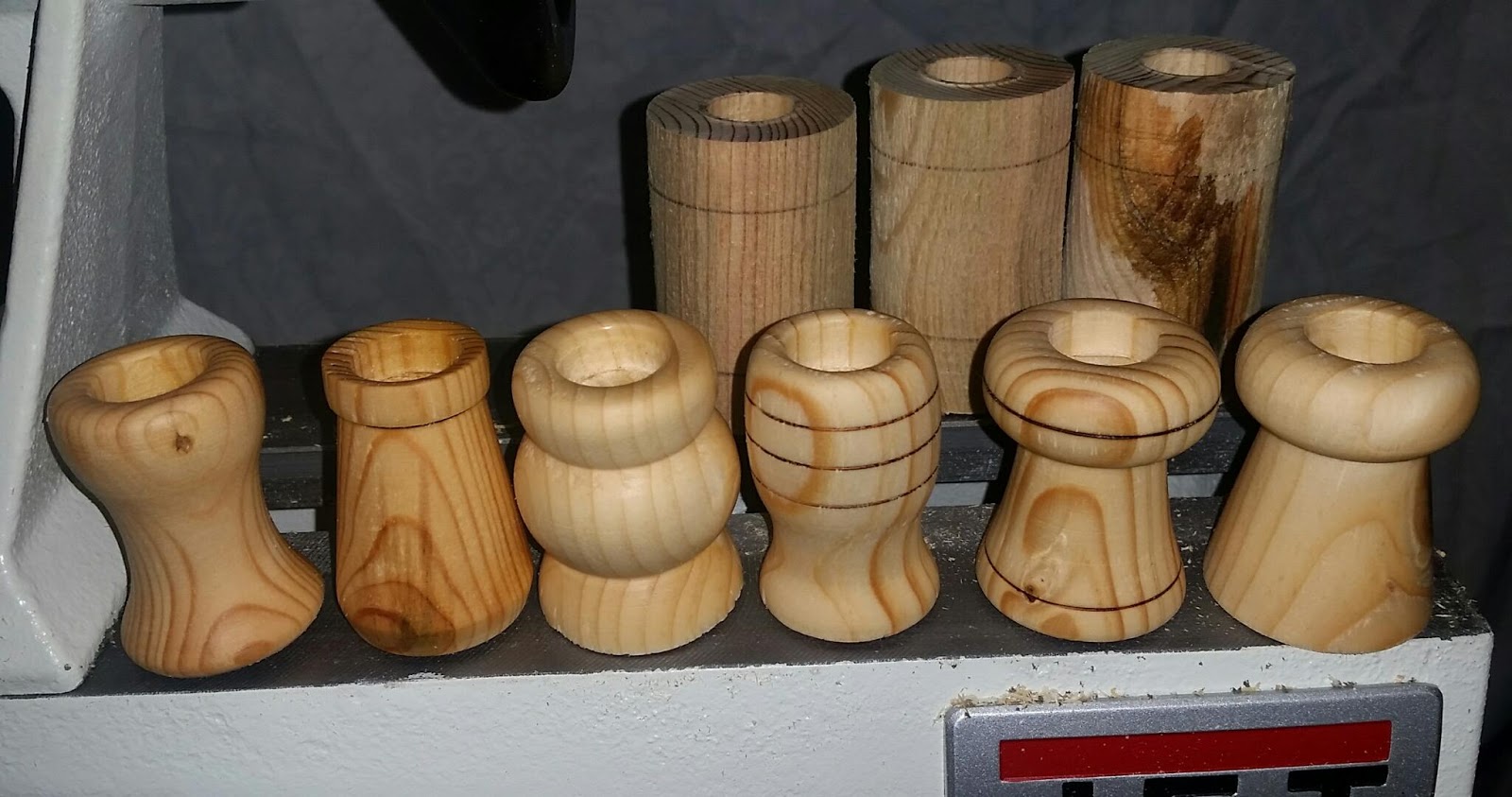
Experimenting with handle shapes

Just seeing what shaving brush handles I can find inside Norwegian spruce wood. I’m sure I’ll find even more and different ones inside my other blanks.